
How to Photograph Cats in the Studio (Without Losing Your Mind or Your Fingers)

Lucifer shows us how its done
Let's get one thing straight. Cats are not small dogs.
I know, groundbreaking revelation, right? But you'd be surprised how many photographers approach a cat photography session with exactly the same expectations they have when photographing dogs. They set up their lights, prepare their backdrop, position their subject and expect everything to go according to plan.
And then the cat arrives.
Unlike dogs, who are often quite happy to participate in whatever ridiculous activity we've planned for them (particularly if there's food involved), cats tend to have their own ideas about how things should unfold. Sometimes those ideas involve sitting beautifully in the perfect position. Other times they involve disappearing behind your backdrop, investigating every piece of equipment or deciding that the inside of their carrier is suddenly the most appealing place on earth.
But here's the thing. Photographing cats in the studio doesn't have to be difficult. You just need to understand that you're working with a very different animal.
I've photographed plenty of cats over the years, and some of my favourite creative images have come from working with them. The secret isn't having an elaborate studio setup or some magical ability to communicate with felines. It's understanding their behaviour, creating an environment where they feel comfortable and learning to work with what they give you.
So, if you're already photographing dogs in the studio and have been considering adding cats to your repertoire, here are a few things worth knowing before your next feline visitor arrives.
Are You Ignoring an Entire Market?
Here's something I've believed for a long time. Cats are one of the most overlooked opportunities in professional pet photography.
There are plenty of photographers out there specialising in dogs, but how many are actively marketing their services to cat owners? My suspicion is that a lot of photographers are ignoring this market simply because they're intimidated by the idea of working with cats.
And I think that's a missed opportunity.
Cat owners love their pets just as much as dog owners do, and they're every bit as capable of investing in beautiful artwork of them. Yet when you look at the marketing and portfolios of many pet photographers, you'd be forgiven for thinking cats barely exist.
I also think there's a bit of a misconception that cats are somehow impossible to photograph in a studio. They're unpredictable, they won't sit, they won't listen and they'll probably spend the entire session hiding under your furniture.
Well, sometimes they will. But I've photographed plenty of dogs who have done exactly the same thing!
The reality is that photographing cats requires a slightly different approach, not an entirely different skill set. And if you're already comfortable working with animals in a studio environment, you've got a pretty good head start.
Rather than seeing cats as difficult subjects, perhaps we should start seeing them as an opportunity. An opportunity to expand our client base, offer something that many other photographers aren't and create some truly wonderful artwork in the process.
Because while everyone else is busy photographing dogs, there are a whole lot of cat owners out there who might just be waiting for someone to photograph their little furry dictators.
1. Cats Aren't Small Dogs. Stop Treating Them Like They Are.
One of the biggest mistakes photographers make is expecting a cat to behave like a dog.
Dogs have spent thousands of years being selectively bred to work alongside humans, and many are naturally inclined to look to us for direction. Cats, on the other hand, are generally far less interested in pleasing us. That's not to say they can't be trained, because they absolutely can, but their motivations and responses can be quite different.
With dogs, I can often encourage a particular pose through a combination of positioning, positive reinforcement and a little patience. With cats, I tend to think more about creating opportunities for the behaviour I want rather than trying to physically position them.
For example, if I want a cat sitting in a particular spot, I'll make that spot appealing and encourage them to investigate it. If I'm after a certain expression, I'll think about what might naturally produce that reaction.
The other important thing to remember is that every cat is an individual.
Some cats will march straight out of their carrier, confidently explore the studio and behave as though they own the place. Others will need considerably more time to feel comfortable, and some simply won't enjoy being in an unfamiliar environment at all.
If you're new to photographing cats in the studio, kittens can be a fantastic place to start. They're often more curious, confident and playful than adult cats, particularly if they've been well socialised. They're usually keen to investigate everything, chase toys and generally cause a bit of chaos, which can make for some wonderful photographic opportunities.
Of course, the downside is that they have the attention span of a goldfish and can go from bouncing off the walls to fast asleep in about thirty seconds. But if you're comfortable working quickly and embracing a little unpredictability, kittens can be an absolute joy to photograph.
Learning to recognise these differences and adjust your expectations accordingly is probably one of the most valuable skills you can develop as a cat photographer.
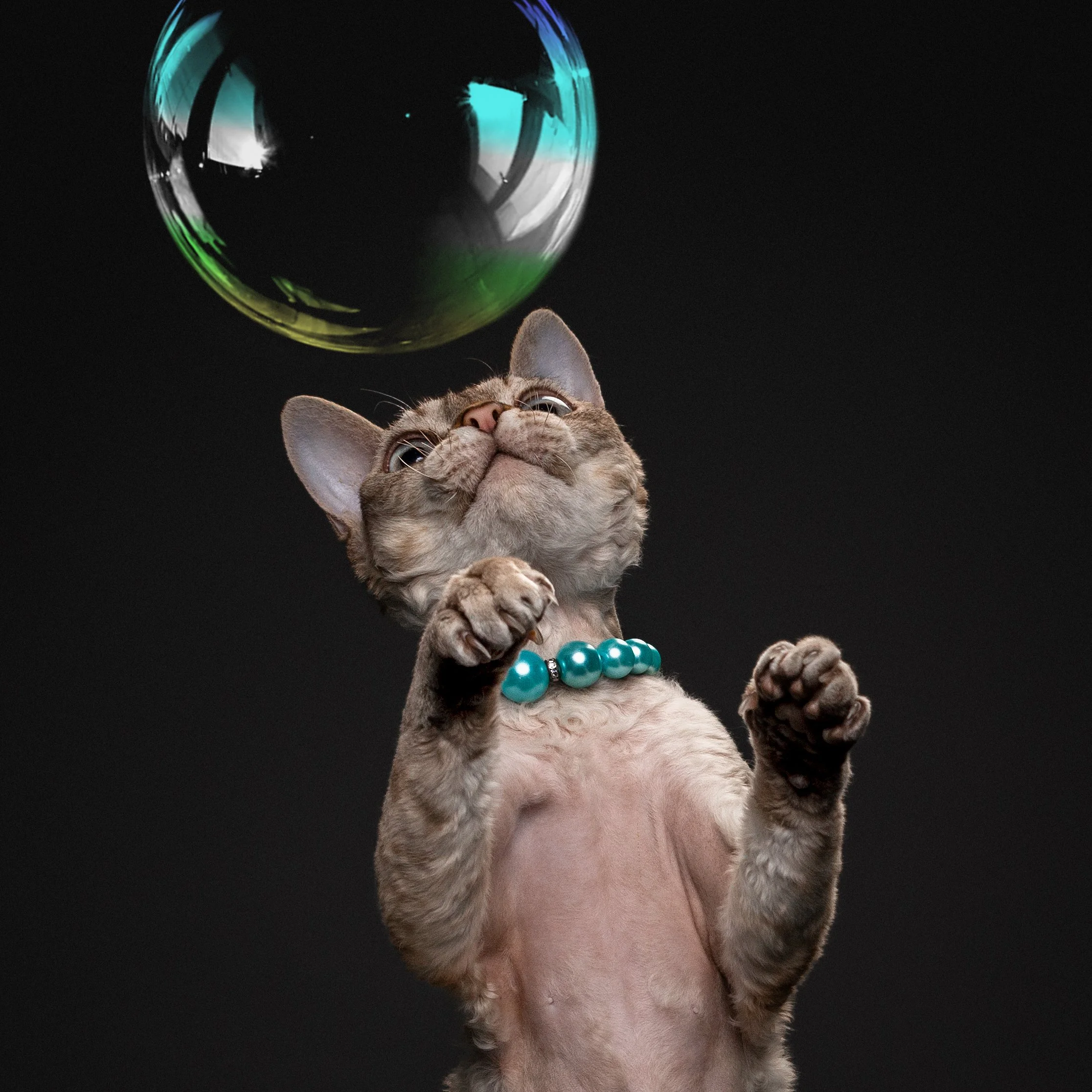
Silvie
2. Preparing Your Studio for a Feline Visitor
Before you even think about picking up your camera, take a good look around your studio.
Now imagine you're a cat.
Where could you hide? What could you climb? Is there anything you could knock over, squeeze behind or become tangled in?
Cats are naturally curious creatures, and an unfamiliar studio full of light stands, cables, furniture and interesting little gaps can be an absolute playground. Unfortunately, not everything in that playground is particularly safe.
I like to make sure the studio is properly prepared before a cat arrives. That means securing equipment, managing cables and checking for any spaces where a frightened or particularly adventurous cat might disappear.
And trust me, if there's a tiny gap behind something expensive and difficult to move, there's a reasonable chance a cat will find it. Underneath my glass trophy cabinet has proved to be a favourite cat destination!
It's also worth considering how much space you're giving them. A large, unfamiliar room can be overwhelming for some cats, so creating a smaller, controlled area can make the experience much easier for everyone involved.
Another little trick worth trying is giving the cat somewhere elevated to sit. Cats often feel more secure when they're up high, where they can observe their surroundings rather than feeling exposed on the floor. A sturdy posing platform, table or other stable, raised surface can sometimes make an enormous difference to their confidence.
Obviously, you need to make sure whatever you're using is safe, stable and appropriate for the individual cat. The last thing you want is a nervous feline launching itself off a wobbly posing table. But sometimes simply changing their perspective is enough to help them relax and settle into a beautiful pose.
I always recommend allowing cats time to explore and become familiar with their surroundings before expecting them to perform in front of the camera. Some will be ready almost immediately, while others may need considerably longer.
A familiar blanket or bedding from home can sometimes help, and it's important that the cat has somewhere safe to retreat if they need a break.
Keep doors and windows securely closed, make sure any other animals are separated and avoid unnecessary noise or activity.
A calm cat is much easier to photograph than a stressed one. And more importantly, the cat's welfare should always come before the photograph.

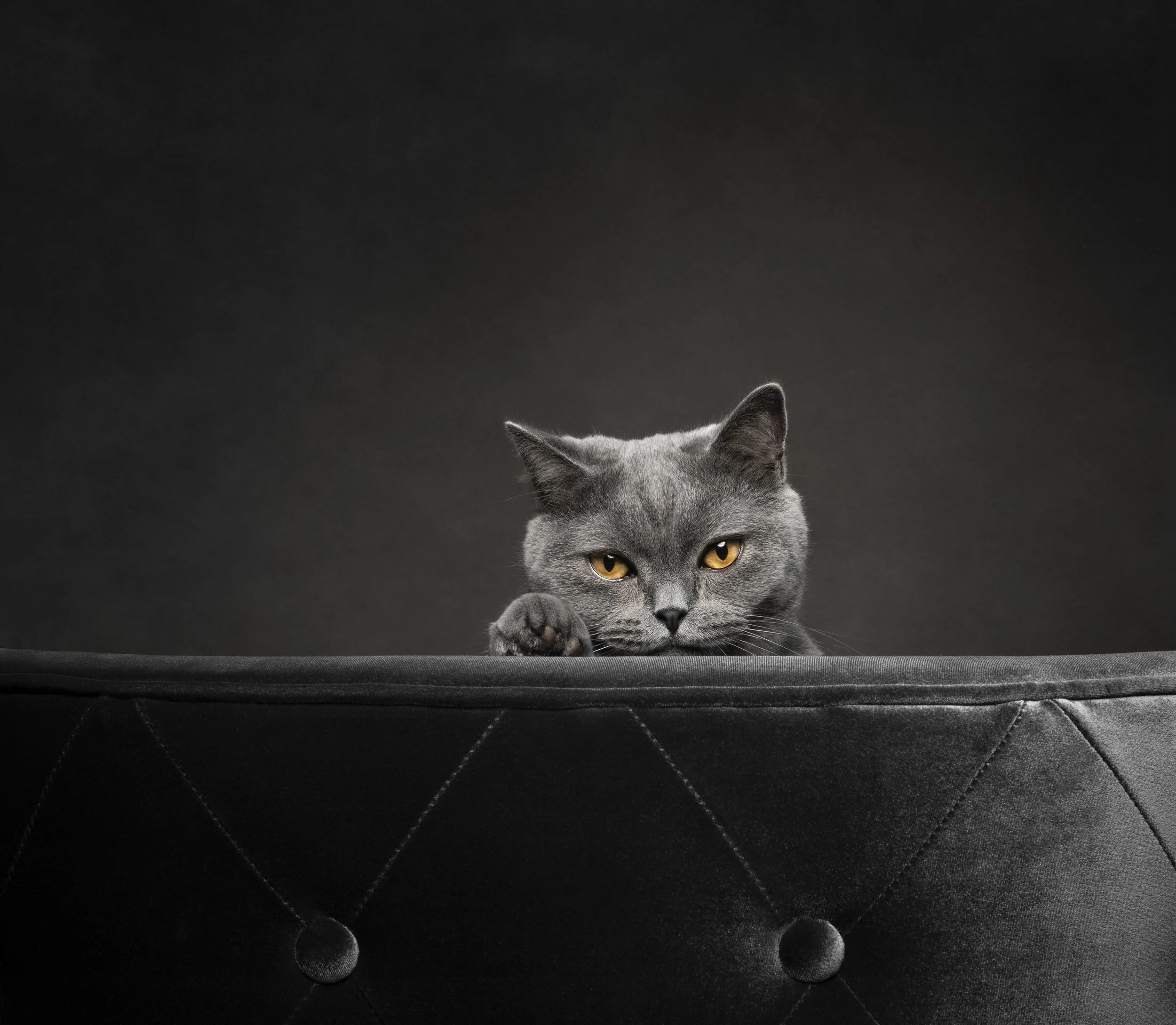
Butter
3. Lighting Cats: Keep It Simple
If you're already comfortable lighting dogs in the studio, you don't need to reinvent everything when a cat walks through the door.
However, there are a few differences worth considering.
Cats have wonderfully varied coat textures, from the incredibly fine fur of a shorthaired breed to the enormous amount of fluff attached to something like a Persian. Then, of course, there are the hairless breeds, where you're dealing with skin texture rather than fur.
All of these surfaces interact with light differently, and understanding how to preserve texture, shape and detail is important.
I also pay particular attention to the eyes. A cat's eyes can be one of the most striking features in a portrait, but they're also highly reflective. The shape, size and placement of your light source can have a significant impact on how those reflections appear.
Another consideration is the cat's response to flash.
Most cats couldn't care less about the flash. Others may be startled by an unfamiliar burst of light, particularly if it's accompanied by a loud recycling beep or other studio noises. My recycling beep is turned off permanently.
I prefer to introduce the equipment gradually and observe how the cat responds rather than assuming they'll be comfortable from the beginning. Keep in mind that a cat can be uncomfortable even if it isn't visibly running away.
You don't necessarily need a complicated lighting arrangement to create beautiful cat portraits. In fact, keeping things relatively simple often gives you more freedom to concentrate on the animal rather than constantly adjusting equipment.
And when you're photographing cats, having your attention on the subject is particularly important. Things can change rather quickly.

Onyx
4. Getting Their Attention Without Starting a Wrestling Match
Getting a cat to look in a particular direction can be an interesting exercise in negotiation.
Some cats respond beautifully to toys, particularly feather wands or objects that mimic the movement of prey. Others are more interested in food, unusual sounds or whatever happens to be going on at the opposite end of the studio.
The trick is discovering what motivates the individual cat.
I like to have a selection of different attention grabbers available rather than relying on one particular toy or technique. What works brilliantly for one cat might be completely ignored by the next.
And let's not forget the power of a good bribe.
While dogs will often sell their souls for a piece of dried liver, cats can be a little more particular about what's worth their time. Small pieces of plain cooked meat, the occasional tiny bit of ham and those squeezable cat treat tubes (otherwise known as cat crack) can be absolute winners.
I particularly love the treat tubes because they're easy for a handler to use and can help encourage a cat into position without too much fuss. Just check with the owner about dietary restrictions and keep any salty human treats to an absolute minimum. Sometimes the quickest way to a cat's heart really is through its stomach. You just need to find the right currency.
Movement can be particularly effective, but it's important not to overdo it.
If you're constantly waving toys around, making noises and trying desperately to get a reaction, you can end up with an overstimulated cat who is far more interested in attacking your equipment than sitting for a portrait.
Not exactly the look we're going for.
This is also where having a good assistant can make an enormous difference.
An experienced animal handler can help encourage the cat's attention while you concentrate on your composition, focus and timing. They can also observe the cat's behaviour from a different perspective and help recognise when it's time for a break.
One thing I would strongly discourage is having several people simultaneously trying to get the cat's attention.
You know the scene. Someone's squeaking a toy, someone else is making kissing noises, the owner is calling the cat's name and the photographer is desperately trying to get eye contact.
Meanwhile, the cat is wondering why all the humans have completely lost their minds.
Choose one person to direct the cat's attention, keep your movements deliberate and give the animal time to respond.
Often, less really is more.

Finn
5. Posing Cats: It's More About Persuasion Than Instruction
One of the things I love about photographing cats is the enormous variety of shapes and expressions they naturally produce.
A beautifully seated cat can look incredibly elegant, while a slightly awkward stretch or unexpected facial expression can be absolutely hilarious.
The challenge is learning to recognise those opportunities and being ready when they happen.
Unlike dogs, where I might spend time refining a particular pose, with cats I'm often thinking about how to encourage a natural behaviour that will produce the shape or expression I'm after.
That might involve using a toy to encourage the cat to look upwards, placing something interesting where I'd like them to sit or simply waiting for them to settle into a comfortable position.
The important thing is to avoid forcing a cat into a pose.
Not only can this create unnecessary stress, but a cat that feels restrained or uncomfortable rarely produces the relaxed body language we're hoping to capture.
Pay attention to their ears, tail, posture and facial expressions. These can tell you an enormous amount about how they're feeling.
A cat with its ears flattened, body tense and tail lashing is probably not enjoying the experience, regardless of how adorable you think the photograph might look.
It's also worth remembering that cats can move incredibly quickly.
You might spend several minutes encouraging a particular position, only for the perfect expression to appear for a fraction of a second before the cat decides it's had enough and walks away.
Being familiar with your equipment and anticipating behaviour will make those fleeting moments much easier to capture.
And sometimes, the best thing you can do is stop trying to direct the cat and simply watch.
They have a remarkable ability to come up with something far more interesting than whatever you originally had planned.
6. Knowing When to Put the Camera Down
This is something I think deserves far more attention in pet photography generally.
Just because an animal is physically capable of doing something doesn't mean we should expect it to.
Some cats are naturally confident, curious and comfortable in unfamiliar environments. Others are much more sensitive to changes in their surroundings, unfamiliar people and new experiences.
It's our responsibility as photographers to recognise those differences.
A cat that is hiding, freezing, repeatedly attempting to escape, showing defensive behaviour or becoming increasingly agitated is communicating something important.
And the answer isn't to keep pushing in the hope that we'll eventually get the photograph.
Sometimes a short break is enough. Sometimes changing the environment or reducing the amount of stimulation can help. And sometimes the best decision is to end the session.
There's absolutely nothing wrong with that.
I would much rather send a cat home feeling safe and comfortable than push an animal beyond its limits for the sake of another photograph.
It's also important to recognise that some cats simply aren't suited to travelling to a photography studio in the first place. For some, the car journey, unfamiliar smells and being away from their own territory can be incredibly stressful, regardless of how carefully we prepare the environment.
And that's perfectly okay. It doesn't mean they should miss out on having beautiful photographs taken.
For cats who are much happier staying in their own environment, I have a photographer I happily recommend who travels to clients' homes. Sometimes the best thing we can do for an animal is recognise that our particular approach isn't the right fit and offer an alternative that puts their comfort first.
This is also why communication with the owner is so important. Before the session, find out what their cat is like at home, how they respond to strangers and unfamiliar environments, and whether there are particular things that frighten or excite them.
A cat that is relaxed and affectionate at home isn't necessarily going to behave the same way in a photography studio.
Understanding that before they arrive can save a great deal of frustration for everyone.
7. Getting Creative With Cats
Now, this is where things get particularly interesting.
I think cats are often overlooked when it comes to creative studio pet photography. We see plenty of traditional cat portraits, but there's so much more potential if you're willing to think beyond the standard sitting pose.
Cats have incredible expressions, interesting body shapes and wonderfully individual personalities. They can be elegant, ridiculous, dramatic, suspicious and downright theatrical, sometimes all within the space of about thirty seconds.

Sneezy Stevie
For a creative photographer, that's a pretty wonderful collection of possibilities.
One of my favourite pieces of artwork, Cattitude, is a great example of how a cat can become the central character in a much more imaginative image.

Moosha gives us Cattitude
Cattitude went on to become the highest scoring print at the 2025 NZIPP Iris Awards, which was an enormous honour. But what I love most about the image is that it demonstrates how much creative potential there is in working with cats.
The finished artwork might look complicated, but the process starts with the same fundamentals as any successful animal portrait. Understanding your subject, knowing what you want to achieve and creating an environment where you can capture the expressions and body positions you need.
For me, creative photography isn't about making an animal do something unnatural or uncomfortable. It's about recognising what makes that particular animal interesting and finding a way to build an image around it.
Sometimes that means developing a concept before the animal arrives. Other times, the animal itself inspires the direction of the artwork.
And occasionally, a cat will give you an expression so wonderfully ridiculous that you'd be mad not to do something with it.
The real creativity comes from recognising those opportunities and knowing how to turn them into a finished piece of artwork.
8. The Cat Is Always in Charge (Well, Almost)
If there's one thing I'd love photographers to take away from this article, it's that photographing cats in the studio doesn't need to be intimidating.
Yes, they're different from dogs. Yes, they can be unpredictable. And yes, there's a reasonable chance you'll spend part of your session wondering why the cat is more interested in an empty cardboard box than your carefully prepared photography setup.
But that's also part of what makes them such wonderful subjects.
The more you understand feline behaviour, the easier it becomes to anticipate their movements, encourage natural expressions and create photographs that genuinely reflect their personalities.
If you're just getting started, confident, well socialised kittens or relaxed adult cats can be wonderful subjects to practise with. Keep your environment safe and uncomplicated, and don't put too much pressure on yourself to achieve a particular result.
Most importantly, be patient.
You're not going to win an argument with a cat, so you might as well save yourself the trouble.
And when everything comes together, there's something incredibly satisfying about creating a beautiful portrait of an animal that had absolutely no intention of cooperating in the first place.
And remember, if you've been avoiding cats because you think they're too difficult, you might also be overlooking an entire market of potential clients.
Perhaps it's time to give our feline friends a little more attention.
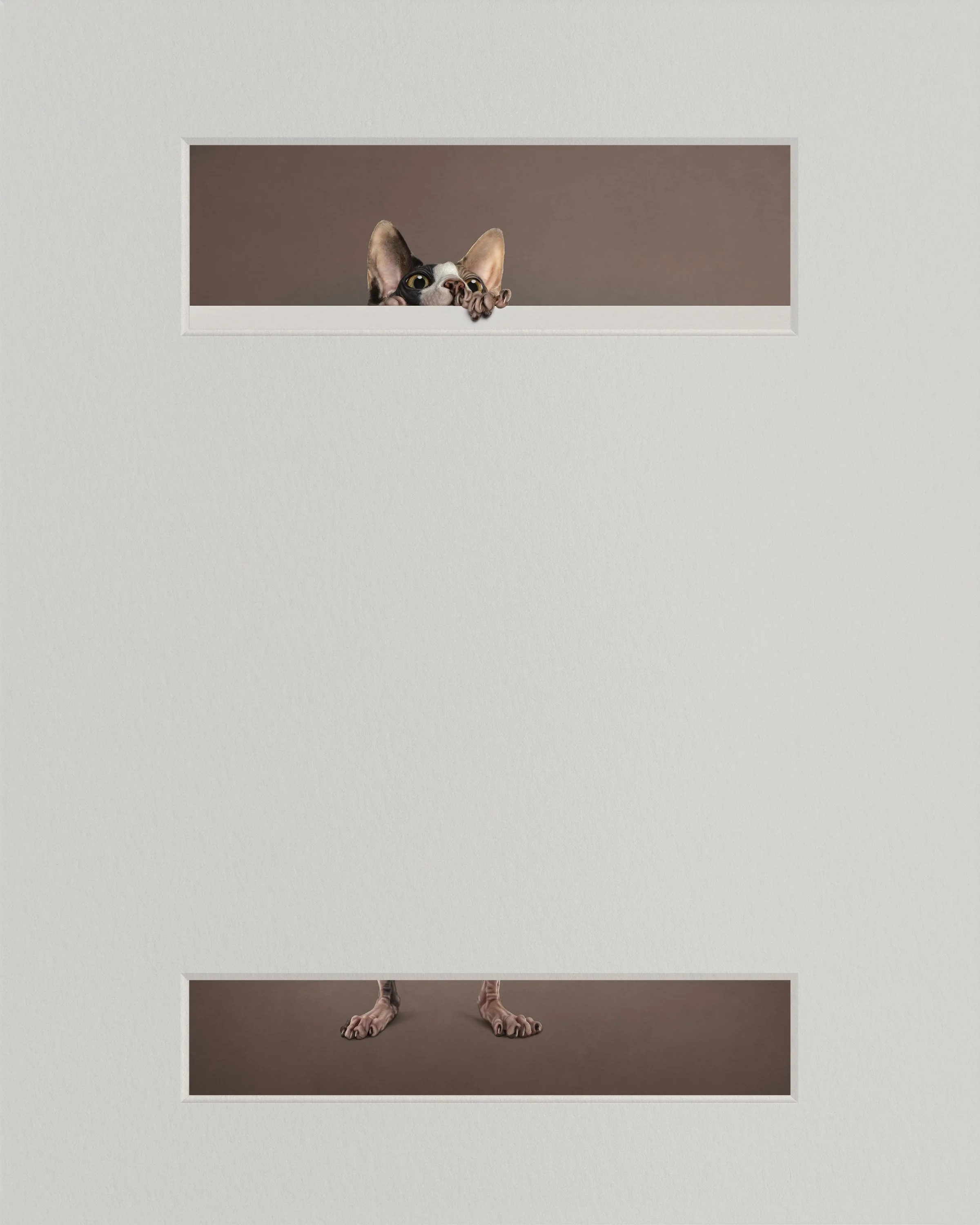
Freya does a peekaboo
Frequently Asked Questions About Studio Cat Photography
Can you use flash when photographing cats?
Yes, studio flash can be used when photographing cats, provided the animal is comfortable with the equipment and the lighting is used appropriately. Introduce unfamiliar sounds and flashes gradually, avoid directing intense light into the cat's eyes and monitor their behaviour throughout the session. Not every cat will respond to flash in the same way.
How do you get a cat to sit still for photographs?
Rather than trying to physically position a cat, encourage it to settle naturally in an appealing location. Toys, treats, familiar objects and patience can all help. Some cats will happily sit for extended periods, while others are better photographed during brief moments between movements. Giving a cat a safe, elevated position can also help some individuals feel more secure.
What is the best way to get a cat to look at the camera?
The most effective method depends on the individual cat. Feather toys, gentle movement, cat treats and interesting sounds can all encourage attention. Having an assistant direct the cat's gaze while the photographer concentrates on capturing the image is particularly helpful.
Are kittens easier to photograph than adult cats?
Kittens can be easier in some respects because they're often more playful, curious and willing to explore unfamiliar surroundings, especially when they've been well socialised. However, they're also easily distracted and can move incredibly quickly. A confident, relaxed adult cat may be easier to photograph than a particularly energetic kitten.
Are all cats suitable for studio photography?
Not necessarily. Some cats are comfortable in unfamiliar environments, while others may find the experience stressful. A cat's temperament, previous experiences and response to new surroundings should all be considered before arranging a studio session. For cats who don't cope well with travel or unfamiliar environments, an in home photography session may be a much better alternative. The animal's welfare should always take priority over the photograph.
Want to Take Your Studio Pet Photography Further?
Working successfully with animals in the studio is about so much more than knowing which camera settings to use. It's understanding behaviour, developing your lighting skills, anticipating movement and learning how to create photographs that are both technically strong and full of personality.
These are some of the skills I explore in my Poses, Pixels, Paws & Profit workshops, where we get hands on with the practical and creative side of studio pet photography, including posing, lighting, animal handling and turning beautiful portraits into artwork that clients love.
If you're ready to build your confidence, refine your skills and explore what's possible beyond the standard pet portrait, I'd love to see you at one of my upcoming workshops.

